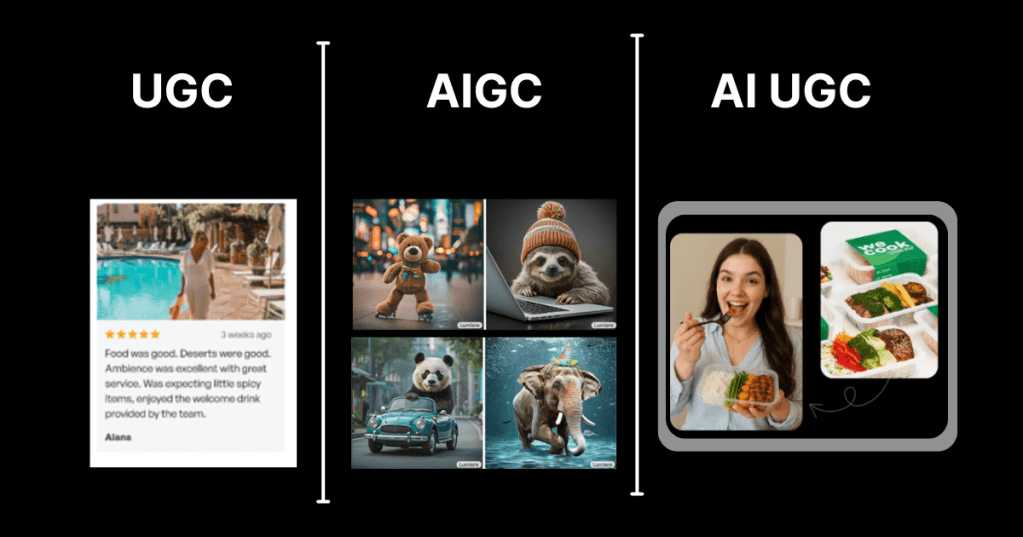
In the world of digital marketing and content creation, three buzzwords have taken center stage lately,UGC, AIGC, and AI UGC.
You’ve probably heard them tossed around on LinkedIn posts, YouTube videos, or by marketers promising “high-converting” content powered by AI. But what do these terms really mean? And more importantly how do they differ from one another?
Let’s break it down simply.
1. What is UGC (User-Generated Content)?
UGC stands for User-Generated Content, and it’s exactly what it sounds like content created by real users, not brands.
Think of a happy customer sharing an unboxing video of your product on TikTok, a five-star review on Instagram Stories, or a testimonial on YouTube. That’s all UGC.
UGC can come in many forms:
- Videos – Product reviews, tutorials, try-ons, or “day-in-the-life” clips featuring your brand.
- Photos – Real-life product shots taken by customers.
- Comments or posts – Tweets, Reddit threads, or testimonials about their experience.
The key here?
UGC is authentic. It’s made by real people who have experienced the brand, not by influencers with scripts or production teams.
Why UGC Works So Well
Let’s be honest people trust people more than brands.
According to studies, over 80% of consumers say they’re more likely to buy from a brand if it features UGC. That’s because UGC feels genuine, relatable, and trustworthy.
It’s the digital version of word-of-mouth marketing.
When potential customers see real users talking about how great a product is, it builds social proof. It shows that others are already using and loving what you’re offering and that creates confidence.
The Challenge with Traditional UGC
While UGC is powerful, it’s not always easy to scale.
If you’re a small brand, you might not have hundreds of customers creating videos or posts for you. You might have to reach out to creators, negotiate deals, send out free products, and wait weeks for content delivery.
That’s where AI starts to shake things up.
2. What is AIGC (AI-Generated Content)?
AIGC stands for AI-Generated Content that’s created entirely by artificial intelligence rather than humans.
This can include:
- Text (like blogs, ad copies, product descriptions)
- Images (AI art, graphics, product renders)
- Videos (AI avatars, explainer videos)
- Voiceovers (AI voices replacing human narration)
Essentially, AIGC uses machine learning and generative models like GPT for text, DALL·E for images, or Synthesia and Pika for videos to create content automatically.
Why AIGC Has Exploded in Popularity
AI tools have dramatically lowered the barrier to creating professional-quality content. What used to take hours of scripting, filming, and editing can now be done in minutes with a single prompt.
For example:
- Marketers use AI to write blog posts and captions.
- Designers use AI to generate product images or ad creatives.
- Video creators use AI avatars and voices to produce full explainer videos no cameras or actors required.
This makes AIGC incredibly scalable. You can generate hundreds of variations of ads or posts with minimal effort.
However… AIGC also has its limitations.
The Catch with Pure AIGC
While AIGC is fast and efficient, it often lacks the human touch.
AI can mimic tone, emotion, and style, but it can’t fully replicate the subtle imperfections and authenticity that come from a real human experience.
A perfectly polished AI video might look great, but it can feel “too perfect” almost robotic. That’s why audiences sometimes tune out AI-only content. It doesn’t always connect emotionally.
So what if we could combine the authentic feel of UGC with the speed and scalability of AIGC?
Enter: AI UGC.
3. What is AI UGC (AI-Generated User Content)?
AI UGC is the next evolution of content creation a blend of UGC and AIGC.
It uses artificial intelligence to create UGC-style content that looks and feels human but is generated (or enhanced) by AI.
Imagine this:
- You upload a script or prompt like: “Create a 15-second testimonial of a woman explaining how this skincare product cleared her acne.”
- In a few minutes, AI generates a talking-head video of a realistic person speaking naturally about the product.
- The tone, gestures, lighting, and even background all look like a real user recorded it at home.
That’s AI UGC user-generated content created by AI.
Examples of AI UGC
Here are a few examples to help visualize what AI UGC looks like:
- AI Talking-Head Videos
Platforms for AI UGC video creation like Tagshop AI, HeyGen, or Synthesia let you generate realistic spokesperson videos perfect for testimonials, product demos, or ads that look like real people talking about a product. - AI Avatars for UGC videos
Instead of hiring dozens of creators, brands can generate UGC-style videos of multiple avatars each representing a different type of customer or audience persona. - AI Voiceovers with Human Tone
Combine real human-style speech patterns with expressive AI voices to create emotional and relatable storytelling. - AI-Enhanced Real UGC
You can even take existing UGC videos and use AI tools to enhance lighting, translate voiceovers, or dub into multiple languages making one video usable for global campaigns.
Why AI UGC is Exploding in 2025
AI UGC has become one of the hottest trends in digital marketing especially for eCommerce, D2C brands, and startups.
Why? Because it solves two major pain points:
- Scalability – Brands can create dozens of authentic-looking videos in hours instead of waiting for real creators.
- Cost-efficiency – No need for expensive shoots, creator deals, or product shipping.
For example, a brand launching a new skincare line can instantly generate 10 testimonial-style videos in different tones, languages, and formats ready to test across TikTok, Meta, and YouTube ads.
4. UGC vs AIGC vs AI UGC: The Core Differences
Let’s put it all side by side for clarity.
| Feature | UGC | AIGC | AI UGC |
|---|---|---|---|
| Created by | Real users/customers | Artificial Intelligence | AI simulating real users |
| Tone & Feel | Authentic, emotional | Polished, sometimes robotic | Natural, human-like |
| Production Time | Slow, depends on creators | Very fast | Fast |
| Cost | Moderate to high | Low | Low to moderate |
| Scalability | Limited | Highly scalable | Highly scalable |
| Trust Factor | High | Moderate | High (if done well) |
| Use Case | Testimonials, reviews | Blogs, ads, explainer videos | Ads, product videos, testimonials |
How Each Fits into a Marketing Strategy
- UGC: Best for building authenticity and trust. Use real users when you can especially for social proof or long-term brand relationships.
- AIGC: Ideal for content scaling, such as generating blog posts, ad copies, or educational videos at speed.
- AI UGC: The sweet spot great for ad creatives, social videos, and product explainers when you want human-like storytelling without production hassles.
5. Why Brands Are Moving Toward AI UGC
Modern consumers scroll fast you have just a few seconds to catch their attention. That’s why brands need content that’s not only engaging but also easy to produce and test.
Here’s why AI UGC is becoming the go-to approach:
1. Speed and Agility
In marketing, timing is everything. AI UGC lets teams produce new video ads, seasonal promos, or A/B variations overnight no waiting for creators or studios.
2. Cost-Effective Scaling
Instead of spending thousands per influencer video, brands can generate dozens of high-quality videos for a fraction of the cost. Perfect for startups or D2C brands testing ad campaigns.
3. Personalization at Scale
AI UGC makes it possible to localize and personalize content changing the avatar, voice, or language to match different target audiences or markets.
4. Multilingual Content Creation
With AI dubbing and translation, brands can create AI UGC videos in multiple languages instantly allowing global reach without additional shoots.
5. Consistency + Control
With real creators, you can’t always control tone or messaging. AI UGC gives full creative control you can adjust scripts, expressions, and delivery to match your brand voice perfectly.
6. But Wait Does AI UGC Replace Real Creators?
Not exactly.
AI UGC doesn’t replace human creators it complements them.
Think of it like this:
- Real UGC gives emotional depth and authenticity.
- AI UGC gives scale, speed, and flexibility.
The most effective brands in 2025 are blending both:
- Using AI UGC videos for paid ads, A/B testing, and quick campaigns.
- Using real creators for organic content, brand storytelling, and community building.
It’s not about choosing one over the other it’s about using both strategically.
7. The Future of Content Creation: Blending Human and AI Creativity
The future of marketing lies in collaboration between humans and AI.
Imagine a workflow where:
- AI generates dozens of UGC-style scripts.
- Humans select and refine the most authentic ones.
- AI avatars bring them to life in multiple languages and formats.
This hybrid model gives brands speed, authenticity, and creativity all at once.
As AI models continue to improve in naturalness and emotional expression, the line between “AI UGC” and “real UGC” will blur even more. The goal won’t be to fake real users but to use AI as a tool to tell human stories at scale.
Final Thoughts
So, what’s the difference between UGC, AIGC, and AI UGC?
- UGC is real human-created content — raw, authentic, and trusted.
- AIGC is AI-created content — fast, scalable, but sometimes impersonal.
- AI UGC is the perfect middle ground — AI-generated but designed to look and feel like genuine user content.
In short, UGC builds trust, AIGC builds scale, and AI UGC builds both.
As technology advances, marketers and creators who learn to harness all three will have a massive advantage creating content that’s not just efficient but emotionally resonant.
Because at the end of the day, even when AI creates the content it’s still humans who connect with it.
 AI Ads
Leave a comment